We suffered a break in at the plot last month, our shed was opened and our kettle, camping stove, and all the stainless steel gardening tools taken, about £150 worth in total, annoying and inconvenient, especially at this time of year when camping gear isnt readily available (or cheap, as it normally only goes on offer at the end of the camping season!)
We've managed to replace most of the tools, with a few things having been bought on special offer from the net, but the one thing we've struggled with is a new stove / kettle. We found a camping stove like the one we had stolen on offer for £15, but no-one has the gas in stock at the moment (or if they do, then its expensive), so after coming across this twig powered kettle, we bit the bullet and ordered one today!
So, this is the new toy for the plot, a 'twig' kettle, boils 1.5litres using a small quantity of twigs in a fairly short time, the design is ingenious!
The base holds a small fire, a bit of paper or straw to start the fire, then a few twigs, the 'kettle' is then placed on top, and more fuel fed thru the central chimney into the base, the water is held in a jacket around the outside, meaning a large volume of water in contact with the heat source, making a fast boil!
In addition a small pan, a small wok and frying pan are also available, so whilst brewing up, a bacon butty or some homemade soup could also be cooked at the same time!
http://www.theselfsufficiencyshop.co.uk/74-15-litre-twig-kettle.html
Ok, its not cheap to purchase in the first place, but being powered by nothing more than a few twigs means no further runnning costs, so comparing with even a basic gas stove (£20 or so, plus gas for the year at £10 or so plus a camping kettle £10) it soon becomes aparent that actually its not that expensive, and with no further running costs it will actually save money in the future, aswell as being very ecologically friendly by not needing any gas (and the inherant waste packaging that is needed for the gas) and running on what is basically a waste product!
It sould be delivered sometime in the next week, so once we've given it a go, we'll report back on whether it is as good in use as it appears in design!
Lee especially is looking forwards to playing with it, he's got a flint and steel that he recons will be ideal for lighting the base, making it even more eco friendly and fun, plus it gives him an excuse to play with fire on the plot all year round! LOL!
I managed to get to the plot for a short while today, to plant the last 50 onion sets, and to get a few piccies of the newly cleared and rebarked paths on plot 2, hopefully I shall get them processed and put up here tomorrow! The chillies, peppers, aubergines and first of the toms we planted last month are all doing really well, almost every windowsill is filled with 1" to 3" tall seedlings at the moment, cant wait till the temperature rises a bit and we can get them planted!
Hope your preparation for the coming growing year is going well!
Sue and Lee's Vegetable Allotment pages, detailing all that we've been doing on our allotments, from clearing the 8' tall weeds that they were covered in when we started with our first plot in October 2006, through to where we are today, with 2 neighbouring full sized productive organic vegetable growing plots, 2 apiaries and 6 Beehives!!
FYI
Clicking on any of the pictures will open them at full size in the browser window, which means you will have to use the 'back' button to return to the main pages, whereas clicking to the left or right of any picture will open them in a new window, if you fancy a closer look at any of the piccies we've posted! We've included a Google Earth satelite picture of our plots and this years planting plan at the bottom of the page, next to each other. If you choose the Earth view on the satelite image you can rotate the image until it is lined up with the planting plan, then use the arrows in the plan to scroll from Plot 2 to Plot 1.
Showing posts with label ecohome. Show all posts
Thursday, February 17, 2011
Wednesday, January 26, 2011
Random 'Energy Descent / Post Peak Oil' Living thoughts and plot progress!
Well, with only tomorrow left of our hols, we've made some progress on the plots, but with the wet, cold and windy weather of the past week, we've not quite done as much as we'd like, however, plenty of research / reading / reskilling has been taking place as I contemplate the possible realities of life after Peak Oil and living in a world which is sufferring Energy Descent!
(For those who arent yet aware of the possibile problems that could be facing us all in the next few years, take a look at some of the links in the Low Imact Living section (on the right of the screen), or take a look at these links for a bit of basic info.......
http://www.lifeaftertheoilcrash.net/ Doom and Gloom Viewpoint?
http://www.postpeakliving.com/peak-oil-primer Post peak living primer.
http://www.postpeakliving.com/guide-to-post-peak-living Post peak living info.
http://en.wikipedia.org/wiki/Peak_oil Peak Oil info - Wikipedia
So, what does it all mean? Basically we've reached (or will soon reach) the point where the amount of Oil we can produce has peaked, although there is still lots of oil in the ground it is going to become more difficult and expensive to extract it (as most of the easy to extract reserves have already been used), yet demand for oil is still rising. This will result in prices getting higher and higher, and a shortfall of the production of oil in relation to its demand, which will push prices even higher.
Our industrialised society relies exclusively on oil to work, we need the fertilizers (which are produced from oil) to grow our food, we need the petrol and diesel to travel to our places of work and for the supermarkets to distribute the food throughout the Uk (typically most Uk Supermarkets have food reserves for only a day or two's supply, if they cant resupply, then they will have empty shelves!), if prices rise for oil, so will everything else, until it reaches a point that we cant afford it and cant travel any longer, we cant afford the prices of basic foods and society is then in danger of falling apart (there have already been food riots in many countries)
You may think that emerging technologies will come online in a manner to reduce our dependance on oil and allow life to continue as it has for the past 40 years or so, but in order to be effective, they need to be coming online NOW, new power stations can take 5 to 20 years to come online (and although they would provide electricity, they wouldnt provide enough in order for us all to have an economically affordable personal transport system) and there are other factors that may prevent them ever becoming the solution to the problem of a world with less / overly expensive oil! (There are problems with the availability of the minerals that are required in order to produce viable electric cars, there isnt enough to allow us to relace all the petrol and diesel cars in the world with electric versions, and how quickly would we be able to produce them anyway?)
There are things we can do, ranging from going totally 'off grid' for all your energy / water / fuel supplies (which needs approx 3 to 5 acres of land per family / commmunity unit) through to less drastic measures such as those advocated by the Transition Town movements. (http://transitionculture.org/ ), (http://www.transitionnetwork.org/ ), who are looking locally at reskilling, building an infrastructure that looks at food and fuel supplies in a world where 10 miles is about as far as you could travel in a day and various other aspects of living in an Energy Descent world.
This is a subject that interests me, not only in relation to how society would fare (would it survive or collapse?), but also in relation to what skills we would need to live in a world where we had to produce the majority of our food, goods, services and fuel locally! Assuming you are able to find a way to provide your home with fresh water (rainwater harvesting and filtration system perhaps?), heating and cooking fuel (woodburning stove with back burenr to rpovide hot water and central heating) and grow enough food to feed yourselves with, then there are a myriad of other things that you need to consider!
Even if you just take a few minutes to look around your kitchen, how many of the things that we use daily could you provide for yourself? Salt? Sugar? Vinegar? Cooking Oil? Tea? Coffee? Milk?
We may know where many of these things come from (such as Salt from mines or from evaporating sea water), but would you be able to source them locally, or even make something that you could trade with others for?
What about those things you need to preserve your crops to allow you to eat them in the winter and spring? Do you know how to make vinegar, how to smoke food, can your surplus crops, how to salt meat (or even where to get the salt from?)
What about something as simple as yeast (for making bread and fermenting excess crops into alcohol - Peak Oil may mean energy descent, but it doesnt mean we need to do without everything thats fun, lol), would you know how to capture wild yeast and cultivate it to bake your own bread?
What about vegetable oil? We're too far north here for olive trees, and a lot of the things we cook need oil, where would you get it from? How about rendering down pig fat for making your own Lard? Or extracting useful vegetable oil from seeds? What about clothing?
Anyhows, if Ive got you thinking, then thats what this post is about, if we start finding out as much as we can now, then when the energy descent begins we should be able to do more for ourselves and pass that knowledge on to others who dont know as much!
A lot of this thinking was prompted by a visit to the Trafford Eco House blog site, a normal family home thats looking at doing what they can to reduce their reliance on oil and fossil fuels, some great ideas (such as their aquaponics system, raising fish in a polytunnel, fish waste feeds bacteria who convert it into plant foods, who then filter the water for the fish, definitely worth a look!)
http://traffordecohouse.wordpress.com/
Another site worth a look, is this one, 3 acres of wasteland in America produces 450000kilos of food and 10000 fish a year, perhaps a way for local communities to feed themselves?
Anyhows, we got to the plot today, planted out the thinnings of Lavender from the seedlings we planted in pots (next to the polytunnel last year) around the edges of the plum tree bed, I pruned the grapevine and we started to bring some fresh bark chips up to the plot to relay the paths, hopefully we should (weather permitting) be able to get the rest of the paths barked up tomorrow!
Thanks for reading!
(For those who arent yet aware of the possibile problems that could be facing us all in the next few years, take a look at some of the links in the Low Imact Living section (on the right of the screen), or take a look at these links for a bit of basic info.......
http://www.lifeaftertheoilcrash.net/ Doom and Gloom Viewpoint?
http://www.postpeakliving.com/peak-oil-primer Post peak living primer.
http://www.postpeakliving.com/guide-to-post-peak-living Post peak living info.
http://en.wikipedia.org/wiki/Peak_oil Peak Oil info - Wikipedia
So, what does it all mean? Basically we've reached (or will soon reach) the point where the amount of Oil we can produce has peaked, although there is still lots of oil in the ground it is going to become more difficult and expensive to extract it (as most of the easy to extract reserves have already been used), yet demand for oil is still rising. This will result in prices getting higher and higher, and a shortfall of the production of oil in relation to its demand, which will push prices even higher.
Our industrialised society relies exclusively on oil to work, we need the fertilizers (which are produced from oil) to grow our food, we need the petrol and diesel to travel to our places of work and for the supermarkets to distribute the food throughout the Uk (typically most Uk Supermarkets have food reserves for only a day or two's supply, if they cant resupply, then they will have empty shelves!), if prices rise for oil, so will everything else, until it reaches a point that we cant afford it and cant travel any longer, we cant afford the prices of basic foods and society is then in danger of falling apart (there have already been food riots in many countries)
You may think that emerging technologies will come online in a manner to reduce our dependance on oil and allow life to continue as it has for the past 40 years or so, but in order to be effective, they need to be coming online NOW, new power stations can take 5 to 20 years to come online (and although they would provide electricity, they wouldnt provide enough in order for us all to have an economically affordable personal transport system) and there are other factors that may prevent them ever becoming the solution to the problem of a world with less / overly expensive oil! (There are problems with the availability of the minerals that are required in order to produce viable electric cars, there isnt enough to allow us to relace all the petrol and diesel cars in the world with electric versions, and how quickly would we be able to produce them anyway?)
There are things we can do, ranging from going totally 'off grid' for all your energy / water / fuel supplies (which needs approx 3 to 5 acres of land per family / commmunity unit) through to less drastic measures such as those advocated by the Transition Town movements. (http://transitionculture.org/ ), (http://www.transitionnetwork.org/ ), who are looking locally at reskilling, building an infrastructure that looks at food and fuel supplies in a world where 10 miles is about as far as you could travel in a day and various other aspects of living in an Energy Descent world.
This is a subject that interests me, not only in relation to how society would fare (would it survive or collapse?), but also in relation to what skills we would need to live in a world where we had to produce the majority of our food, goods, services and fuel locally! Assuming you are able to find a way to provide your home with fresh water (rainwater harvesting and filtration system perhaps?), heating and cooking fuel (woodburning stove with back burenr to rpovide hot water and central heating) and grow enough food to feed yourselves with, then there are a myriad of other things that you need to consider!
Even if you just take a few minutes to look around your kitchen, how many of the things that we use daily could you provide for yourself? Salt? Sugar? Vinegar? Cooking Oil? Tea? Coffee? Milk?
We may know where many of these things come from (such as Salt from mines or from evaporating sea water), but would you be able to source them locally, or even make something that you could trade with others for?
What about those things you need to preserve your crops to allow you to eat them in the winter and spring? Do you know how to make vinegar, how to smoke food, can your surplus crops, how to salt meat (or even where to get the salt from?)
What about something as simple as yeast (for making bread and fermenting excess crops into alcohol - Peak Oil may mean energy descent, but it doesnt mean we need to do without everything thats fun, lol), would you know how to capture wild yeast and cultivate it to bake your own bread?
What about vegetable oil? We're too far north here for olive trees, and a lot of the things we cook need oil, where would you get it from? How about rendering down pig fat for making your own Lard? Or extracting useful vegetable oil from seeds? What about clothing?
Anyhows, if Ive got you thinking, then thats what this post is about, if we start finding out as much as we can now, then when the energy descent begins we should be able to do more for ourselves and pass that knowledge on to others who dont know as much!
A lot of this thinking was prompted by a visit to the Trafford Eco House blog site, a normal family home thats looking at doing what they can to reduce their reliance on oil and fossil fuels, some great ideas (such as their aquaponics system, raising fish in a polytunnel, fish waste feeds bacteria who convert it into plant foods, who then filter the water for the fish, definitely worth a look!)
http://traffordecohouse.wordpress.com/
Another site worth a look, is this one, 3 acres of wasteland in America produces 450000kilos of food and 10000 fish a year, perhaps a way for local communities to feed themselves?
Anyhows, we got to the plot today, planted out the thinnings of Lavender from the seedlings we planted in pots (next to the polytunnel last year) around the edges of the plum tree bed, I pruned the grapevine and we started to bring some fresh bark chips up to the plot to relay the paths, hopefully we should (weather permitting) be able to get the rest of the paths barked up tomorrow!
Thanks for reading!
Thursday, August 13, 2009
I have always had a Dream..........
The more that I find our modern society with its consumer based lifestyle leaving me cold, the more I yearn for my dreams of living in a sustainable low impact way with the land (rather than off it) to become a reality!
Life in the modern world has now become totally detached from the world around us, greed and the pursuit of more 'things' has become the driving force for most, yet without the next 'fix' of what is new, it is an addicts lifestlye that leaves us all finally unfulfilled and jaded with society. As a society we've lost our spiritual connection with the land, in many cases we've lost those skills that would allow us to survive were we deprived of all our modern tools and gadgets, yet anyone that harks back to a simpler and more fulfilling way of life is at best seen as odd, and at worst criminalised by the state!
Given the chance I would love to take on 4 or 5 acres of varied land, containing a piece of woodland (that could be coppiced for building materials and for wood to provide both heat and a crop that could be bartered or sold to help provide those items we are unable to produce for ourselves!), a field or two that could be used for rearing animals and growing feed for their winter eating (chickens for both eggs and eating, a couple of pigs for bacon and pork, a few goats for milk, a housecow for both milk and beef, possibly some sheep for both wool and meat), an area where we could have a large veg patch (not only to feed ourselves, but also to provide income via a possible veg box scheme), an area for a small orchard that could house our bee hives and perhaps the chickens and pigs (another few possible sources of income) and a place where we could build our own low impact earth sheltered home.
Kind of like a River Cottage kind of life, but with the added attraction of a self built eco home, heated by wood from our own woods (with hot water from a back boiler and solar water heaters to augment one another depending on the season), cooking done on camp fire in the summer and in a solid fuel aga in the winter, solar panels, wind turbine and possibly a small waterwheel to provide electricity (for the few mod cons like computer, low voltage lighting, freezers to store produce, etc). Perhaps we'd even consider having a few Yurts that we could rent out for holidays to those who seek an escape into the wilderness, or even run a few courses for those interested in a similar type of life, or even a few pagan camps where likeminded folks can get together.
Sounds idyllic doesnt it? Yet I know that both Lee and I are no fools, we know just how hard work such a life would be, how unlikely it would be to gather enough income to support ourselves in a 'traditional way', but if we were able to succesfully harvest enough to live on, then the need for actual cash would be minimal (some clothes, a few things we cant produce for ourselves (sugar, salt, medicines, etc), a few luxuries, council tax etc) and could possibly be found from selling crops via a veg box scheme, renting out yurts, holding courses and possibly even a part time job or two!
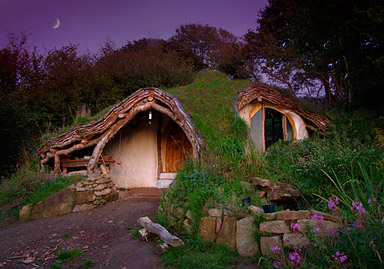
If we were to sell up, get rid of all our possessions and our home, then we could probably net about £25K, enough to buy about 5 acres of agricultural land, kit it out with the livestock and tools we would require and allow us to build a house along the lines of the one in the picture at the top of this post (http://www.simondale.net/house/index.htm), allowing us to acchieve our dream and assume the lifestyle we want, living in a sustainable way with minimal impact to the environment! Sure it wouldnt always be a comfortable life, and certainly not an undertaking to be contemplated lightly, but certainly its something that we would both love to do!
"Great, problem solved, lets go and do it!", you may say, however, there's just one tiny problem!
In the UK even if you own the land, you cannot live on it unless you have planning permission, and although there is talk of sustainability at all levels within society at the moment, this does not fully apply to planning laws!
The problem is that the UK planning laws were put into place with laudable intentions of preventing the land being overly developed, in many places it is almost impossible to get residential planning permission, even if you have a case that shows that you need to live on the land to farm it efficiently. You can easily buy land without planning permission, but you cant live on it, which then means you have to either then also buy a place to live or rent somewhere, with the costs that are associated, meaning the plans for a low impact small holding become financially unsustainable!
'Ok, then why not buy somewhere with planning permission then?' I hear you ask? Great, we'd love to, but as the price for land with planning permission is extreme when compared to the price for agricultural land, then this becomes impossible with the current level of funds we could realise!
So, we find ourselves stuck in a catch 22 situation, we know what we would like to do about it, but cant currently proceed due to UK planning law, hence the reason I set up the petition on Number 10's website to create a new class of Low Impact Development Land to allow those of us who wish to live in a different manner to do so!
Please sign the petition at http://petitions.number10.gov.uk/LowImpactLiving/
To add some more food for thought, take a look at the links to the right under the Low Impact Living heading, definite food for thought, especially as peak oil, global warming and global population rise start to have an impact and global resources start to rise in price!
Subscribe to:
Posts (Atom)