With working weekends we dont seem to get much time to get to the plot after work atm, but after not seeing any evidence of the emerged queen (or eggs/larvae) in the last nucleus we took (after 3 weeks and seeing that the queen cell is open) when we did the bee inspections this week, we decided that the four of us would open up the hive and make a thorough check on Sunday, so we all met up at the plot after work to have a look!
Lee and I arrived first, so after watering in the greenhouses and ploytunnel we suited up, although not as thoroughly as we normally do!
As you can see, here we have the 'Tesco Beekeeper', Lee, still in uniform (though I dont think they'd let him wear his wellies to work, I was also in my uniform, which is black in colour and consists of cargo type pants (that are fairly form fitting) and tshirt, and seeing as we weren't planning on being in the apiaries for too long, I put my bee jacket over the top of my uniform! This proved to be something of a mistake!
Now, normally I wear gaiters over my shoes, to seal the trouser legs (and prevent bees from crawling up them, which has happened once before, and normally results in a sting to your leg when you move - as the trousers then squash the been against your leg and it retaliates by stinging you!), but seeing as we werent doing a full inspection, I didnt bother with my gaiters, and also forgot the fact that bees dont like black clothing, it makes them think you are a 'bear' come to steal their honey, not a great situation when you've got black trousers on and are upsetting them by opening the hive!
So,as Pat and Colin hadnt yet arrived, Lee lit the smoker and we went into apiary 1 to have a look at hive 7 (aka the nucleus)! On opening the hive and having a good look, we have to conclude that its gone queenless, there's no sign of eggs, grubs, larvae or a queen in evidence anywhere within the hive, so we've only got a couple of choices of what we can do with it!
Without a queen present the hive will not survive, and with no eggs present, then the workers cant raise an egg to become a queen, so they are doomed unless we do one of two things! The 2 choices we have are to combine it with another hive (possibly hive 1 as this is our weakest colony), by putting the brood boxes above each other, separated by a layer of newspaper (once the bees have eaten their way through, then they will already have gotten each others scent, so wont fight and will combine happily together), or (as its still - just about - early enough for a new queen to be mated and start laying) we could give them a frame of eggs to enable them to raise an egg as a queen and hopefully the colony will then become strong enough to survive!
We decided to take a frame of eggs from Hive 3 (in the other apiary) as this is a hive with calm bees and thats nice and strong, so after sealing up hive 7 temporarily we moved over to apiary 2 to see if we could get a frame of eggs to move! As we went into Apiary 2 it was to find that our smoker had gone out, so Lee quickly relit it!
Hive 3 is a strong colony, and has 4 supers on it at the moment, so before we could remove a frame we had to remove the 4 (heavy) supers, then the queen guard before we could start looking for a frame of newly laid eggs! As I removed the first frame of bees from hive 3 they realised I was wearing black trousers, so one decided to sting me on my leg straight away! Ouch!
We then found the smoker had gone out again, and the bees were getting upset at being disturbed at such a late hour, so there were a lot of angry bees flying around! We managed to find a good frame of newly laid eggs, removed it and gently shook the bees off the frame, only to find that some of the uncapped honey from the frame then flew out and landed on my black trousers! This sent the now angry bees into a bit of a feeding frenzy, so my legs were covered in bees, and worse than that, I could feel them crawling up inside my trouser legs!!!
Pat and Colin arrived at this point, to find me stood with my legs unmoving, a frame of eggs in my hand and Lee laughing! Pat relit the smoker, then took the frame of eggs over to hive 7 (in the other apiary) and closed up that hive, before coming back to us!
Lee had managed to clear the bees off his legs by this time (gently brushing them off), so he got the smoker and smoked me to remove as many of the bees from my trousers as possible, but I was stuck with bees inside my trousers, if I'd have moved either leg they would have stung me, and I could feel them getting higher, one was already above my knee!
I tried lifting my trouser leg, but as my work trousers are fairly form fitting, I couldnt raise them far enough without risking squashing a bee and receiving a sting, so only 1 alternative was available to me........ I'd have to take my trousers off! Ok, I'm no prude, its not something that I'm accustomed to, but it doesnt worry me, except for the 200000 stings flying angrily around the enclosed space of the apiary!
Nothing for it though, either I remove my trousers and hopefully get the bees out without a sting, or try to walk out and invariably get a sting! I got Lee to give me a thorough smoking, then managed to remove my trousers without getting stung (although I'm sure my bottom made a nice target for some of the bees to aim for) and freed the trapped bees, before exiting the apiary, luckily without any more stings!
The only good thing about the whole situation though, is I'm gald I wasnt 'going commando' today, as that definitely could have been embarrassing, not to say downright painful! Lol! And, before you ask, no, I didnt let anyone get any pictures of me trouserless in the apiary, you'll just have to take my word for it!
Anyhows, the nucleus in Hive 7 has a frame of freshly laid eggs now, so we'll let them alone for a couple of weeks and see whether they manage to requeen themselves!
I havent shared any piccies of the polytunnel recently, so I tok a couple today, the toms in there are fruiting well, but with it being soo close to the fence and hedges its quite shaded in there, so they arent as far on as the ones in the greenhouses............
............. mind you, I have to say that the lavender we grew from seed has done fantastically well! Some of this is going to be transplanted into the front of Plot 1 next year, as underplanting of the plum tree we hope to plant there!
Anyhows, the moral of the beekeeping exerience, dont think you can just quickly do anything where bees are concerned, and dont cut corners with your bee protection! I was lucky today, I could easily have been stung a lot more than the once that I was!
Hope your plots are cropping well, and if you have bees, I hope they are behaving themselves and not forcing you to do a naked dance around your apiary! Lol!
Thanks for reading, more updates to follow soon!
Sue and Lee's Vegetable Allotment pages, detailing all that we've been doing on our allotments, from clearing the 8' tall weeds that they were covered in when we started with our first plot in October 2006, through to where we are today, with 2 neighbouring full sized productive organic vegetable growing plots, 2 apiaries and 6 Beehives!!
FYI
Clicking on any of the pictures will open them at full size in the browser window, which means you will have to use the 'back' button to return to the main pages, whereas clicking to the left or right of any picture will open them in a new window, if you fancy a closer look at any of the piccies we've posted! We've included a Google Earth satelite picture of our plots and this years planting plan at the bottom of the page, next to each other. If you choose the Earth view on the satelite image you can rotate the image until it is lined up with the planting plan, then use the arrows in the plan to scroll from Plot 2 to Plot 1.
Showing posts with label nucleus. Show all posts
Sunday, August 08, 2010
Friday, July 09, 2010
Beekeeping Update 8th July 2010
Today we return to work after our holidays, Lee has already left to start at 730am, I'm on a Late shift today, so have to leave in a couple of hours, so please excuse us if the blog updates become a bit less regular than they have been for the past 2 weeks, working full time + looking after 2 full size allotments and 6 hives of bees does eat up a hefty amount of time, but rest assured, I will do my best to keep you updated of our progress on the plots!
Yesterday we did the inspections on our Bees, we currently have 6 hives in the 2 apiaries on our plots, the first apiary is on Plot 2, and the newer larger one (apiary 2) is on plot 1, confusing, but we know where they are!
Apiary 1 was first built in late 2008 / early 2009 (http://dobbyspumpkinpatch.blogspot.com/2009/05/building-apiary.html) and took our first 3 hives in June and July 2008, whereas apiary 2 was built in early 2010 (http://dobbyspumpkinpatch.blogspot.com/2010/05/17th-may-2010-update-piccies-more-bees.html)
So, onto the bee inspections! We inspect the bees for several reasons, to check their health, to see if there are eggs, larvae and sealed brood, to see the queen and to check for swarm signs such as play cups (empty cups that could be the beginnings of a queen cell) and queen cells. If left unchecked and a queen cell is capped, then the existing queen and a lot of the bees will swarm, which not only can be a nuisance, but also can result in their deaths if they dont find a suitable home within 3 days, as their honey supplies will then run out!
We started with Apiary 1, which contains Hives 1 & 2, both Smiths designs and the first 2 hives we got! Hive 1 is a smaller colony (we had fears they wouldnt survive the winter, but having made it through ok, we are willing to give them a chance to get established this year rather than requeening the colony), whereas Hive 2 is a very strong and productive colony!
Normally there's 4 or 5 of us to do the inspections, Pat and Colin, sometimes their daughter Sarah, and Lee and myself, so we usually split into 2 teams to tackle 1 apiary each, making the process a lot quicker than it would be if we all did it together, but as Pat and Sarah have gone away to Hampton Court Flower Show it meant with just the 3 of us present that we did the inspections together.
We started with Hive 1, which has a single brood box and a single 'super'.
The first thing to do is to check the floor inserts for signs of varroa drop. Varroa mite originated in the East, but was brought into the UK with imported bees, it is a main pest for the bees and can seriously weaken a colony, and natural UK bees have no defenses, so we have to take steps to keep the bees clear of varroa by treating once a year (in midwinter) with oxalyic acid and weekly by dusting them with icing sugar (it makes the bees give themselves a really good clean, which causes the varroa to fall off, and as we have mesh floors, the mites fall through the mesh and are expelled from the colony. Checking the floor inserts gives us a good idea of the quantity of varroa present, which fortunately seems to be very low at the moment!
Once the roof is removed we then remove the crown board, this keeps the bees in the hive and stops any unwanted visitors from getting in via the top.
Under the crown board are the 'supers' shallower boxes that hold shallower 'super' frames where the bees store their supplies, both honey and pollen. Depending on the hive you can have up to 7 supers on a colony, which the bees will fill with supplies, then 'cap' the honey with a thin layer of wax to keep the honey safe. Once a super is 90% capped it can be taken and the honey extracted in a centrifugal extractor, then filtered and bottled for our use. (If you'd like to take a look at a bit more info from the blog on how a hive is constructed, then take a look here http://dobbyspumpkinpatch.blogspot.com/2009/07/beekeeping-another-colony-homed-3-hives.html)
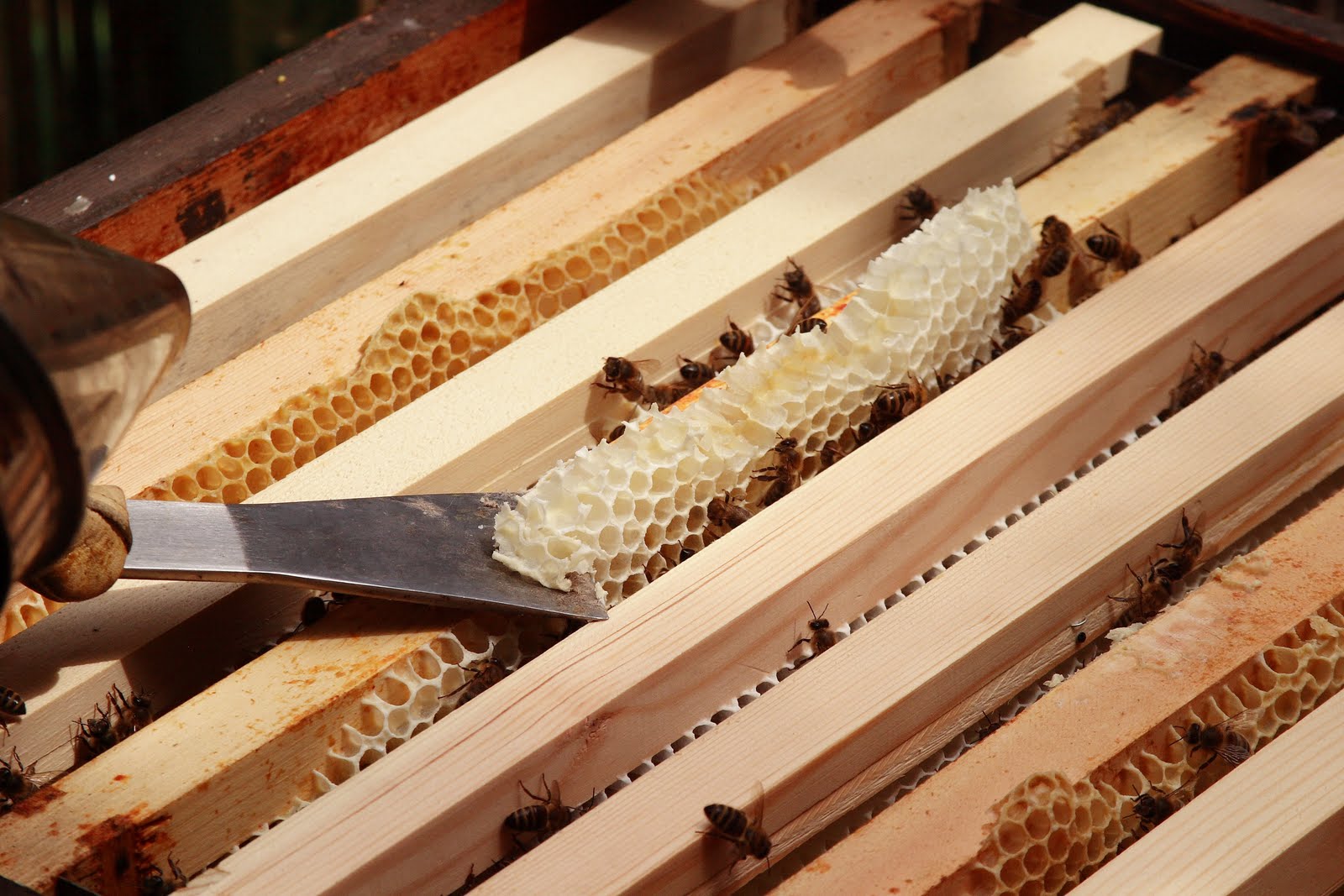
The bees not only draw out the foundation to make the cells, but also build 'bridging comb', which makes removing the frames for examination difficult and is generally removed (the wax is then extracted and used for making lip balm, furniture polish and candles).
Lee inspecting a super frame to see how they are doing with the honey. The bees work on the honey to reduce its moisture content so that it wont ferment and go off, once the moisture content is right for storage, then they cap the cells, and once all the frames are fully capped, then any excess honey can be harvested by the beekeeper (each hive generally needs a full brood box and super of honey stores to see them safely through the winter), this frame is partially capped, with thin white veneer of wax to keep the honey fresh and the moisture content correct for storage!
Removing the bracecomb!
Next we remove the super to reveal the queen excluder and brood box! The queen excluder stops the larger queen from going into the supers and laying eggs in with the honey stores, which makes it easier to take the honey without damaging the health of the colony by having eggs, grubs and larvae mixed in with the honey that you are trying to extract!
Worker bees in the hive!
The queen is much larger than the workers or drones, the longer bee in the center of the pic (marked with a green dot which denotes she is last years queen) is the queen in Hive 1.
A drone, more bulky and 'square' in shape than a worker, these male bees have only 1 purpose in life, to mate with a queen.
A drone amongst the workers!
Once we are happy with the inspection (that we've seen eggs, larvae and capped worker brood or seen the queen - not always possible), then we treat the brood box with icing sugar, sifting it through a mesh to dust the bees and make them have a good clean in the hopes of controlling varroa mite infestation.
Once dusted the bees take on a different aspect, looking a bit like 'ghost' bees!
Cleaning themselves nicely!
After that the hive is reassembled and left alone for another week, happy in the knowledge that the bees are ok.
Hive 2 is our strongest colony, the queen is that productive we've had to give her a super to lay in aswell as the brood box (hence the green band of the queen excluder is above the bottom brown super box. This hive now has 5 supers, 4 of which are drawn out and filled / partially capped / almost filled, with 1 new one that we added today!
In the center of the picture is the queen on this hive, shes a great producer, laying thousands of eggs a day!
In doing the inspection in here we did find some 'play cups' pictured here next to some capped drone brood (the drone brood is much taller and domes, whereas the worker brood is almost flat to the frames. Any play cups are best removed, by squishing them with a hive tool.
This worker bee decided to investigate the taste of my gauntlet!
So, onto Apiary 2! From Left to Right, Hives 4, 5, 6 (Stingray), our original Hive 3 (that swarmed earlier this year and we rehomed into the National its not living in) and a nucleus box (homemade of course!) Hives 4 and 5 are smiths design, but Hives 3 and 6 are both the more popular (at least locally) National design, they both use similar frames (but the smiths have shorter lugs), the main differences are the exterior design (smiths have routed handles - usually- and Nationals have an extra piece of wood on the sides that make a bigger handle) and the position of the 'beespace', smiths have a top bee space, whereas national hae a bottom beespace! (The beespace is 1/8", and allows the bees to transit the space easily, any larger and they will fill it with braceomb, any smaller and they cant get in, so will seal it with bracecomb and propolis!
All was well in Hives 4, 5 and 6, but on opening Hive 3 we found 2 queen cells, this capped one......
.......... and this uncapped one. The 2 bees to the left of the queen cell are newly emerged worker bees, which stay in the hive for their first couple of weeks, acting as nurse bees by feeding the larvae and building any comb that needs to be drawn out.
Looking in from the uncapped end you can just see the queen larvae. The egg is fed with royal jelly for 5 days, then the grub growns on until the cell is capped and the new queen emerges 9 days later. If left with nothing done, a colony with a queen cell will normally swarm, so depending on time of year (after early July has passed it is unlikely the new nucleus will have enough time to get established and set down enough stores to see them through the winter) you can either split the colony, or later in the year we sadly have to remove the queen cells.
These 2 cells (along with a frame of stores, a frame of eggs and a frame of brood) were placed in a nucleus box and moved into apiary 1, its a bit late to take a split, but hopefully there will be just enough time for them to establish themselves, ready for the winter!
The new nuclues in apiary1.
Once finished its wise to check yourself for bees before removing your protective suit, as you can see here, Lee has a few bees investigating him!
So, thats the inspections done for another week! Hope it was of some interest, and thanks for reading!
Yesterday we did the inspections on our Bees, we currently have 6 hives in the 2 apiaries on our plots, the first apiary is on Plot 2, and the newer larger one (apiary 2) is on plot 1, confusing, but we know where they are!
Apiary 1 was first built in late 2008 / early 2009 (http://dobbyspumpkinpatch.blogspot.com/2009/05/building-apiary.html) and took our first 3 hives in June and July 2008, whereas apiary 2 was built in early 2010 (http://dobbyspumpkinpatch.blogspot.com/2010/05/17th-may-2010-update-piccies-more-bees.html)
We started with Apiary 1, which contains Hives 1 & 2, both Smiths designs and the first 2 hives we got! Hive 1 is a smaller colony (we had fears they wouldnt survive the winter, but having made it through ok, we are willing to give them a chance to get established this year rather than requeening the colony), whereas Hive 2 is a very strong and productive colony!
We started with Hive 1, which has a single brood box and a single 'super'.
After that the hive is reassembled and left alone for another week, happy in the knowledge that the bees are ok.
So, thats the inspections done for another week! Hope it was of some interest, and thanks for reading!
Labels:
beekeeping,
drone,
nucleus,
play cup,
queen,
queen cell,
split,
worker bee
Monday, May 17, 2010
17th May 2010 - Update, piccies & More Bees!!
This brings our total number of colonies now to 9, the 3 that overwintered, 4 divisions from them, 1 swarm from hive 3 and another swarm of unknown origins! We are going to keep our original 3 colonies, plus the swarm from hive 3 and 2 more of the colonies, the others (plus any further divisions we get this year) will be sold to local beekeepers to help them recover from the losses over the winter that many suffered!
Hope you like the piccies, more updates to foollow soon!
Subscribe to:
Posts (Atom)